Main grammar
...will...
| eu voi | noi vom |
|---|---|
| tu vei | voi este |
| el/ea va | ei/ele vor |
| (it) va |
Would
| Eu as | Noi am |
|---|---|
| tu ai | Voi ați |
| el/ea ar | Ei/ele ar |
| (it) ar |
a fi - to be
| eu sunt | noi suntem |
|---|---|
| tu esti | voi sunteți |
| el/ea este | ei/ele sunt |
| (it) este |
She will buy a house here. = Ea va cumpăra o casă aici.
to sleep - a dormi
I will go to sleep = eu voi dormi
to drink - a bea
a avea - to have
| Eu am | Noi avem |
|---|---|
| Tu ai | Voi aveți |
| El/ea are | ei/ele au |
To want - a vrea
To go - a merge
To sleep - a dormi
To be able to/can - a putea
To work - a lucra
To buy - a cumpâra
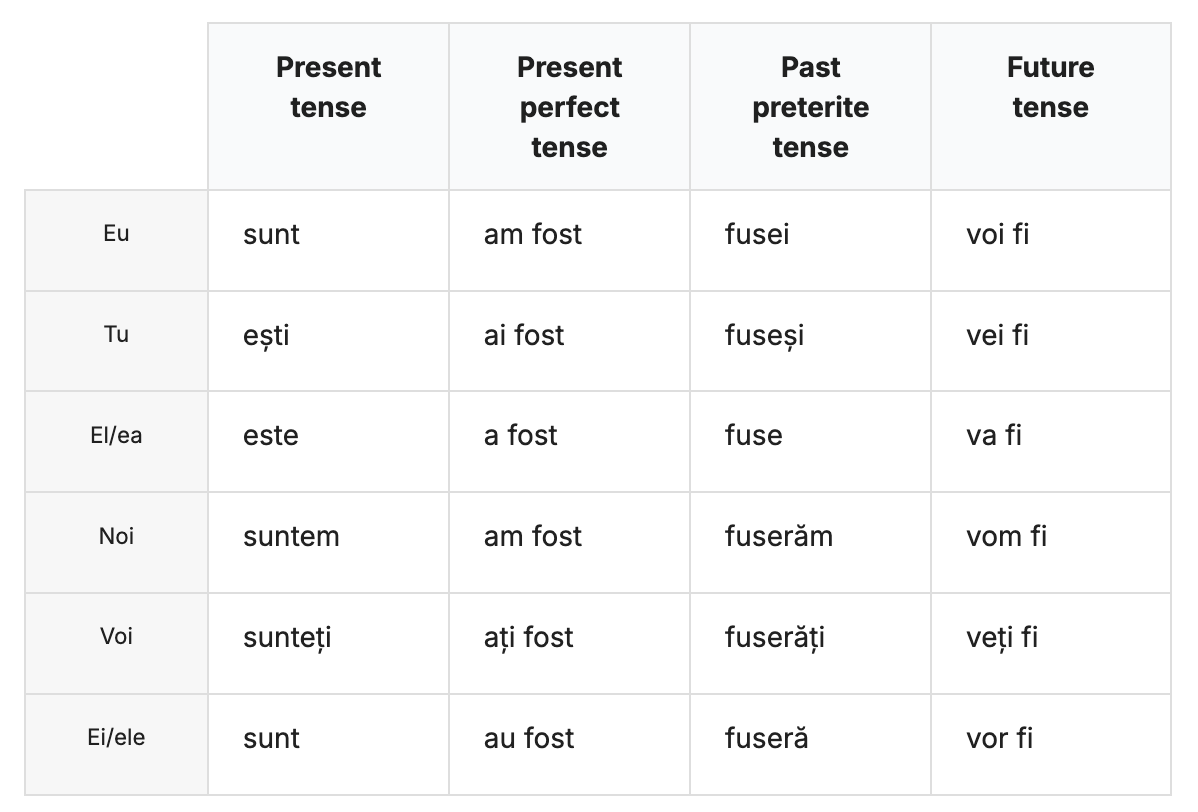
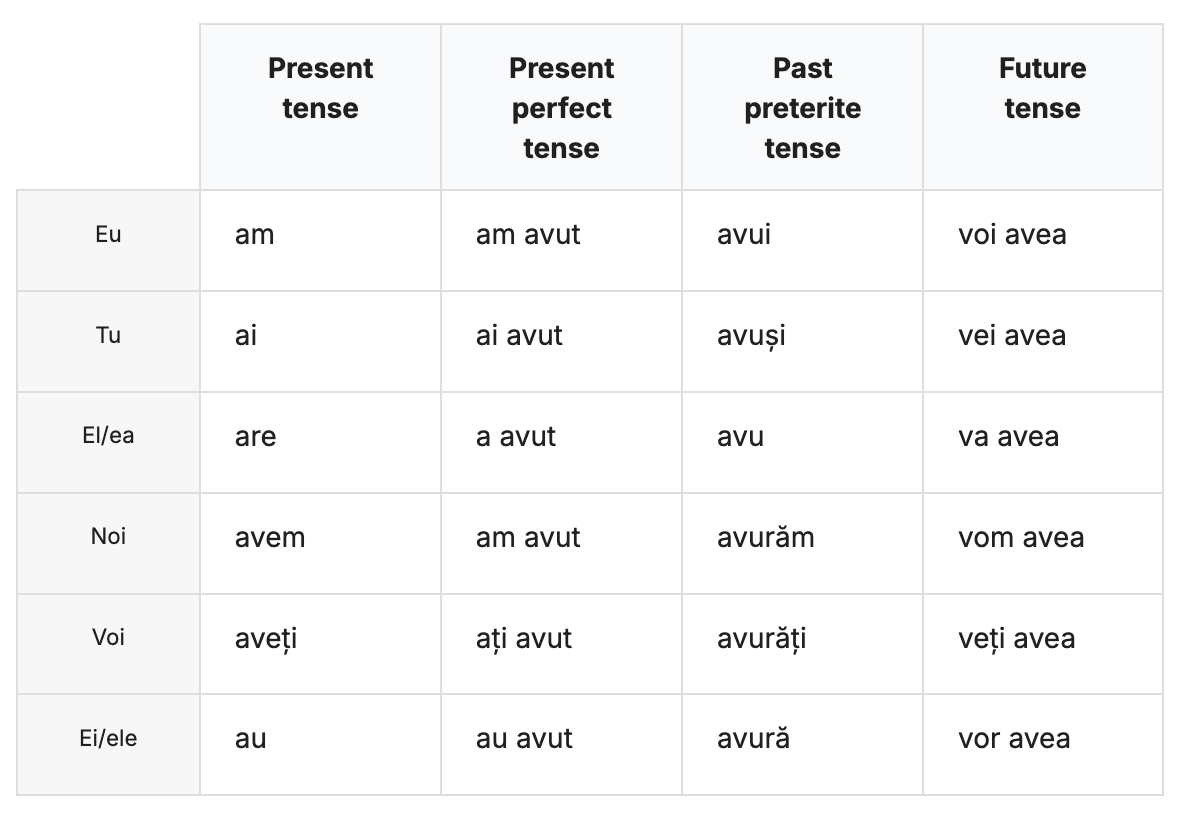
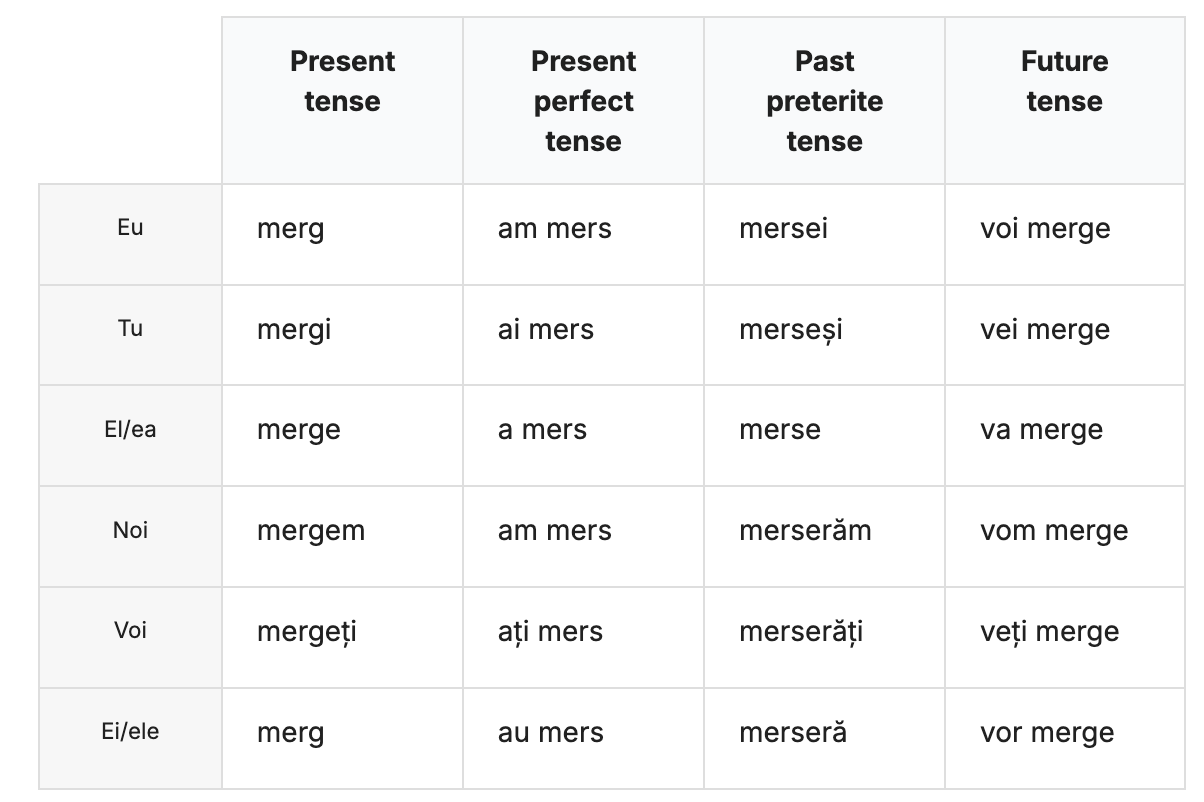
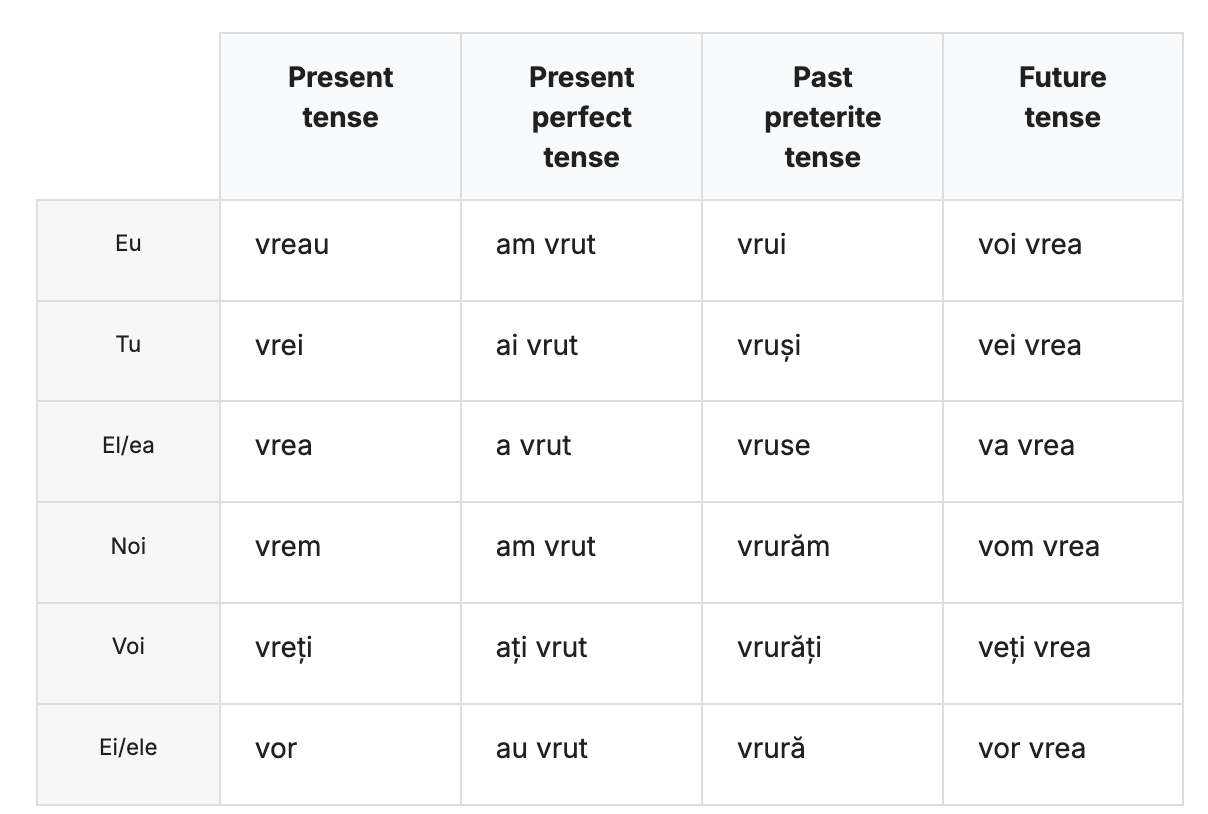
***Note: This section has been taken from https://learnromanian.org/romanian-grammar
Gender of Nouns
Romanian nouns have three genders: masculine, feminine, and neuter. Unlike English, where nouns do not have gender, Romanian nouns are classified by gender, which affects the articles, adjectives, and pronouns used with them.
-
Masculine nouns: These usually refer to male beings or objects considered grammatically masculine.
Example: băiat boy, copac tree -
Feminine nouns: These refer to female beings or objects considered grammatically feminine.
Example: fată girl, floare flower -
Neuter nouns: These behave like masculine nouns in the singular and feminine nouns in the plural.
Example: telefon phone, scaun chair
Knowing the gender of a noun is crucial because it determines the form of the articles and adjectives that accompany the noun.
Number of Nouns
Romanian nouns have two numbers: singular and plural. The plural form of nouns is formed by adding specific endings, depending on the noun's gender.
-
Masculine plurals often end in -i or -uri.
Example: băiat becomes băieți boys, copac becomes copaci trees -
Feminine plurals usually end in -e, -i, or -uri.
Example: fată becomes fete girls, floare becomes flori flowers -
Neuter plurals can end in -e, -i, or -uri, depending on the word.
Example: telefon becomes telefoane phones, scaun becomes scaune chairs
Irregular plurals exist in Romanian, so some nouns do not follow standard rules. These must be memorized as you encounter them.
Definiteness and Articles
Romanian has both definite and indefinite articles. Unlike in English, where the definite article (the) is placed before the noun, Romanian uses enclitic articles, meaning the definite article is attached to the end of the noun.
-
Indefinite article (a/an):
Masculine: un băiat a boy
Feminine: o fată a girl
Neuter: un telefon a phone -
Definite article (the):
Masculine singular: băiatul the boy
Feminine singular: fata the girl
Neuter singular: telefonul the phone
In the plural, the definite articles are different:
Masculine plural: băieții the boys
Feminine plural: fetele the girls
Neuter plural: telefoanele the phones
Cases of Nouns
Romanian nouns have five cases: nominative, accusative, genitive, dative, and vocative. These cases indicate the noun’s role in the sentence, whether it is the subject, the object, or used to express possession, etc.
-
Nominative: Used for the subject of the sentence.
Example: Băiatul citește The boy is reading -
Accusative: Used for the direct object of the sentence.
Example: Văd băiatul I see the boy -
Genitive: Used to show possession.
Example: Cartea băiatului The boy’s book -
Dative: Used to indicate the indirect object.
Example: Îi dau băiatului o carte I give the boy a book -
Vocative: Used for direct address.
Example: Băiete, vino aici! Boy, come here!
Noun-Adjective Agreement
In Romanian, adjectives agree with the nouns they modify in gender, number, and case. This means that the form of the adjective changes depending on the noun.
-
Masculine singular: băiat frumos beautiful boy
-
Feminine singular: fată frumoasă beautiful girl
-
Neuter singular: telefon frumos beautiful phone
-
Masculine plural: băieți frumoși beautiful boys
-
Feminine plural: fete frumoase beautiful girls
-
Neuter plural: telefoane frumoase beautiful phones
Possession
Possession in Romanian is expressed using the genitive case, often with possessive adjectives or pronouns. The noun being possessed takes the genitive form, and the possessor follows in the genitive case.
Example:
Cartea profesorului The teacher’s book
Casa prietenului The friend’s house
Nouns Derived from Verbs
Many Romanian nouns are derived from verbs by adding specific suffixes. These nouns often describe actions or results of actions.
Example:
Verb: a scrie to write
Noun: scriere writing
Verb: a vorbi to speak
Noun: vorbire speech
1. Nominative Case – The Subject of the Sentence
The nominative case is used for the subject of a sentence or for predicates. It answers the questions "Who?" (cine?) or "What?" (ce?).
Examples:
-
Fata citește o carte – The girl is reading a book.
-
Copacul este înalt – The tree is tall.
In these examples, fata (the girl) and copacul (the tree) are in the nominative case because they are the subjects of their respective sentences.
2. Accusative Case – The Direct Object
The accusative case is used for the direct object of a sentence, answering the questions "Whom?"(pe cine?) or "What?" (ce?). It is often marked by the preposition pe when referring to specific or definite animate nouns.
Examples:
-
Văd pe băiat – I see the boy.
-
Cumpăr o floare – I am buying a flower.
In the first sentence, pe băiat (the boy) is in the accusative case because it is the direct object. The preposition pe is required because the object is a definite person. In the second example, o floare (a flower) is the direct object, but since it is indefinite and inanimate, no preposition is needed.
3. Dative Case – The Indirect Object
The dative case indicates the indirect object, answering the questions "To whom?" (cui?) or "For whom?" (pentru cine?).
Examples:
-
Îi dau o carte lui Andrei – I am giving a book to Andrei.
-
Am scris prietenului meu – I wrote to my friend.
In the first sentence, lui Andrei (to Andrei) is in the dative case, as it is the recipient of the action. In the second example, prietenului meu (to my friend) is also in the dative case, showing to whom the action of writing was directed. The dative is typically marked by the suffix -ului for masculine and neuter nouns and -ei for feminine nouns.
4. Genitive Case – Possession and Relationships
The genitive case expresses possession and relationships between nouns. It answers the questions "Whose?" (al cui?) or "Of what?" (a ce?).
Examples:
-
Cartea fetei este nouă – The girl’s book is new.
-
Culoarea florii este roșie – The color of the flower is red.
In the first sentence, fetei (of the girl) is in the genitive case, indicating possession of the book. In the second example, florii (of the flower) is in the genitive case, showing that the color belongs to the flower. Like the dative case, the genitive is also marked by specific endings: -ului for masculine and neuter nouns and -ei for feminine nouns.
Possessive adjectives in Romanian, such as meu (my), tău (your), său (his/her/its), nostru (our), and vostru (your), agree in gender, number, and case with the noun they modify.
5. Vocative Case – Direct Address
The vocative case is used when directly addressing someone or something. It often appears in spoken language and informal contexts. Vocative forms are sometimes accompanied by interjections such as o (oh) or hei (hey).
Examples:
-
Maria, vino aici! – Maria, come here!
-
Hei, prietene, ce faci? – Hey, friend, what are you doing?
Vocative forms can differ slightly from the nominative, especially for feminine nouns. For example, fată (girl) in the nominative becomes fato in the vocative when addressing someone directly.
Additional Notes on Case Usage
-
Prepositions and Cases: Many Romanian prepositions require specific cases. For example, cu(with) and fără (without) are followed by the accusative, while datorită (thanks to) and conform (according to) require the dative.
-
Definite and Indefinite Articles: In Romanian, the definite article is attached to the end of the noun (e.g., băiatul – the boy, floarea – the flower). The form of the article changes according to the case, gender, and number of the noun.
-
Pronouns and Cases: Personal pronouns in Romanian change form depending on the case. For example, the first-person singular pronoun eu (I) becomes mă (me) in the accusative and îmi(to me) in the dative.
Definite Articles (Articolele hotărâte)
In Romanian, definite articles are added to the end of the noun, unlike English, where they appear as a separate word ("the"). The form of the article depends on the noun’s gender, number, and case.
Examples:
-
băiatul (the boy) – masculine, singular
-
fata (the girl) – feminine, singular
-
cartea (the book) – feminine, singular
-
copiii (the children) – masculine, plural
-
casele (the houses) – feminine, plural
a. Masculine Singular:
-
un băiat (a boy) → băiatul (the boy)
-
un câine (a dog) → câinele (the dog)
b. Feminine Singular:
-
o fată (a girl) → fata (the girl)
-
o carte (a book) → cartea (the book)
c. Plural (Masculine and Feminine):
-
niște băieți (some boys) → băieții (the boys)
-
niște fete (some girls) → fetele (the girls)
Indefinite Articles (Articolele nehotărâte)
Indefinite articles in Romanian function similarly to those in English, indicating that the noun is unspecific. These articles are placed before the noun.
Examples:
-
un băiat (a boy) – masculine, singular
-
o fată (a girl) – feminine, singular
-
niște băieți (some boys) – masculine, plural
-
niște fete (some girls) – feminine, plural
a. Masculine Singular:
-
un băiat (a boy)
-
un profesor (a teacher)
b. Feminine Singular:
-
o fată (a girl)
-
o profesoară (a teacher - feminine)
c. Plural (for both genders):
-
niște copii (some children)
-
niște cărți (some books)
Gender-Specific Usage of Articles
Romanian nouns are categorized as masculine, feminine, or neuter, and this affects how articles are used:
-
Masculine nouns: Use un for indefinite singular and -ul for definite singular.
- Example: un cal (a horse) → calul (the horse)
-
Feminine nouns: Use o for indefinite singular and -a for definite singular.
- Example: o floare (a flower) → floarea (the flower)
-
Neuter nouns (which behave as masculine in singular and feminine in plural):
-
Example: un scaun (a chair) → scaunul (the chair)
-
Plural: niște scaune (some chairs) → scaunele (the chairs)
-
Articulated Nouns in Context
When nouns are modified by adjectives or are part of a prepositional phrase, the definite article remains attached to the noun, but other elements may appear in between.
Examples:
-
băiatul mare (the big boy)
-
cartea interesantă (the interesting book)
-
copiii din parc (the children in the park)
Demonstratives and Definite Articles
In Romanian, demonstrative pronouns (e.g., this, that, these, those) can appear with definite nouns to emphasize specificity.
Examples:
-
băiatul acesta (this boy)
-
fata aceea (that girl)
-
casele acestea (these houses)
-
copiii aceia (those children)
Personal Pronouns
Personal pronouns indicate specific people or things. They change form depending on whether they are the subject, object, or possessive pronouns.
Subject Pronouns
These pronouns are used as the subject of a sentence. Romanian subject pronouns are often omitted because the verb conjugation already indicates the subject.
-
Eu – I
-
Tu – You (informal)
-
El – He
-
Ea – She
-
Noi – We
-
Voi – You (plural/informal)
-
Ei – They (masculine or mixed group)
-
Ele – They (feminine group)
Example sentences:
-
Eu vorbesc română. – I speak Romanian.
-
Ea citește o carte. – She is reading a book.
-
Noi mergem la piață. – We are going to the market.
Object Pronouns
Object pronouns are used when the pronoun receives the action of the verb. In Romanian, they can be either direct or indirect object pronouns.
-
Mă – Me
-
Te – You (informal)
-
Îl – Him/It (masculine direct object)
-
O – Her/It (feminine direct object)
-
Ne – Us
-
Vă – You (plural or formal)
-
Îi – Them (masculine direct object)
-
Le – Them (feminine direct object)
Example sentences:
-
Mă vezi? – Do you see me?
-
Îl ajutăm pe el. – We help him.
-
O iubesc. – I love her.
Possessive Pronouns
Possessive pronouns indicate ownership and must agree in gender and number with the noun they refer to.
-
Al meu / A mea / Ai mei / Ale mele – Mine
-
Al tău / A ta / Ai tăi / Ale tale – Yours (informal)
-
Al lui / A ei – His / Hers
-
Al nostru / A noastră / Ai noștri / Ale noastre – Ours
-
Al vostru / A voastră / Ai voștri / Ale voastre – Yours (plural or formal)
-
Al lor / A lor – Theirs
Example sentences:
-
Cartea aceasta este a mea. – This book is mine.
-
Casa este a lor. – The house is theirs.
-
Pixul este al lui. – The pen is his.
Reflexive Pronouns
Reflexive pronouns are used when the subject and object of the sentence are the same person. In Romanian, reflexive pronouns are often used with reflexive verbs.
-
Mă – Myself
-
Te – Yourself (informal)
-
Se – Himself / Herself / Itself / Themselves
-
Ne – Ourselves
-
Vă – Yourselves (plural or formal)
Example sentences:
-
Mă spăl pe mâini. – I wash my hands.
-
Te trezești devreme. – You wake up early.
-
Ei se pregătesc pentru examen. – They are getting ready for the exam.
Demonstrative Pronouns
Demonstrative pronouns indicate specific objects or people, distinguishing them by distance or position relative to the speaker.
-
Acesta / Aceasta – This one (masculine / feminine)
-
Aceștia / Acestea – These ones (masculine / feminine)
-
Acela / Aceea – That one (masculine / feminine)
-
Aceia / Acelea – Those ones (masculine / feminine)
Example sentences:
-
Acesta este fratele meu. – This is my brother.
-
Aceea este profesoara mea. – That is my teacher.
-
Acestea sunt cărțile mele. – These are my books.
Interrogative Pronouns
Interrogative pronouns are used to ask questions about people or things.
-
Cine – Who
-
Ce – What
-
Care – Which
-
Cui – Whose
Example sentences:
-
Cine este acolo? – Who is there?
-
Ce faci? – What are you doing?
-
Care este al tău? – Which one is yours?
-
A cui este această carte? – Whose book is this?
Relative Pronouns
Relative pronouns introduce relative clauses, providing additional information about a noun.
-
Care – Who / Which / That
-
Cine – Who (used without a specific antecedent)
-
Ce – What (used without a specific antecedent)
-
Cui – Whose
Example sentences:
-
Omul care vorbește este profesor. – The man who is speaking is a teacher.
-
Fata căreia i-am dat cadoul este verișoara mea. – The girl to whom I gave the gift is my cousin.
-
Ce spui este adevărat. – What you say is true.
Indefinite Pronouns
Indefinite pronouns refer to non-specific people or things.
-
Cineva – Someone
-
Ceva – Something
-
Oricine – Anyone
-
Orice – Anything
-
Nimeni – No one
-
Nimic – Nothing
Example sentences:
-
Cineva a sunat la ușă. – Someone rang the doorbell.
-
Nu am văzut nimic. – I didn’t see anything.
-
Poți să iei orice vrei. – You can take anything you want.
Coordinating Conjunctions: Addition, Contrast, Choice, Explanation
Copulative (addition): și, iar, nici
- și adds; iar adds with a mild contrast or topic shift; nici adds a negated element (requires prior negation).
Maria citește și scrie zilnic.
Maria reads and writes daily.
El lucrează dimineața, iar ea învață seara.
He works in the morning, and she studies in the evening.
Nu vreau ceai, nici cafea.
I don’t want tea, nor coffee.
Disjunctive (choice): sau, ori, correlatives fie…fie, ori…ori
- sau is neutral and most frequent; ori is more formal/literary; fie…fie and ori…ori balance alternatives.
Mergem cu trenul sau cu autobuzul?
Are we going by train or by bus?
Fie rămânem aici, fie plecăm acum.
Either we stay here, or we leave now.
Adversative (contrast/correction): dar, însă, iar, ci
- dar is general “but”; însă is “however” (slightly more formal); iar often contrasts topics; cicorrects a negated element and must follow a negation.
Am vrut să vin, dar am întârziat.
I wanted to come, but I was late.
A promis, însă nu a reușit.
He promised, however he didn’t manage to.
Nu mănânc pește, ci legume.
I don’t eat fish, but vegetables.
Explicative/resultative connectors: căci, deci
- căci = “for/because” (literary/explanatory); deci = “so/therefore” (often a discourse connector).
Nu plec, căci plouă tare.
I’m not leaving, for it’s raining hard.
Nu avem timp, deci începem acum.
We don’t have time, so we start now.
Correlative Conjunctions (Two-Part Linkers)
Romanian frequently balances structure with paired linkers: și…și, nici…nici, fie…fie, ori…ori, nu numai…ci și, atât…cât, cu cât…cu atât, pe de o parte…pe de altă parte.
Și profesorul, și studenții au participat.
Both the professor and the students participated.
Nici el, nici ea nu știau răspunsul.
Neither he nor she knew the answer.
Nu numai a citit, ci și a comentat textul.
He not only read, but also commented on the text.
Cu cât lucrezi mai constant, cu atât progresezi mai repede.
The more consistently you work, the faster you progress.
Subordinating Conjunctions: Building Complex Sentences
Subordinating conjunctions introduce dependent clauses. They may require specific moods (especially the subjunctive after să) and particular word orders.
Content/Complement Clauses: că, să, dacă
- că introduces declarative content after verbs of saying/thinking; să introduces subjunctive complements (desires, commands, necessity); dacă introduces indirect questions or conditions depending on context.
Știu că ai dreptate.
I know that you are right.
Vreau să pleci mai devreme.
I want you to leave earlier.
Întreb dacă vine mâine.
I’m asking whether he is coming tomorrow.
Causal Clauses: deoarece, fiindcă, pentru că, întrucât
- Register nuances: deoarece is formal/neutral; fiindcă and pentru că are common in speech; întrucât is formal.
Am rămas acasă, deoarece eram obosit.
I stayed home because I was tired.
Nu ies, pentru că plouă.
I’m not going out because it’s raining.
Final (Purpose) Clauses: ca să, pentru a, pentru ca… să
- ca să is very common in speech; pentru a is formal with the infinitive; pentru ca… să introduces a finite clause with emphasis.
Închid ușa, ca să nu intre frigul.
I close the door so that the cold doesn’t come in.
A studiat mult, pentru a reuși.
He studied a lot in order to succeed.
Spun asta pentru ca tu să înțelegi.
I say this so that you understand.
Consecutive (Result) Clauses: încât, astfel încât, patterns atât de… încât / atât de mult… încât
- Use these to express a consequence strong enough to trigger a result.
A plouat atât de tare, încât străzile s-au umplut de apă.
It rained so hard that the streets filled with water.
A explicat clar, astfel încât toți au înțeles.
He explained clearly, so that everyone understood.
Concessive Clauses: deși, chiar dacă, cu toate că, măcar că
- Express contrast against expectation. deși and chiar dacă are most frequent.
Deși era târziu, am continuat.
Although it was late, we continued.
Mergem, chiar dacă ninge.
We are going, even if it snows.
Cu toate că a plouat, concertul a avut loc.
Despite the fact that it rained, the concert took place.
Conditional Clauses: dacă, numai dacă, în caz că / în cazul în care
- dacă is the core conditional; numai dacă narrows the condition (“only if”).
Dacă termini, ieșim la plimbare.
If you finish, we’ll go for a walk.
Te ajut numai dacă îmi spui adevărul.
I will help you only if you tell me the truth.
Temporal Clauses: când, după ce, înainte să / înainte de a, până când, de îndată ce / imediat ce
- înainte să + subjunctive; înainte de a + infinitive; după ce takes an indicative perfect for completed events.
Când ajungi, sună-mă.
When you arrive, call me.
Înainte să plec, îmi verific e-mailul.
Before I leave, I check my email.
După ce am mâncat, am plecat.
After we ate, we left.
Aștept până când termini.
I wait until you finish.
Comparative Clauses: ca, precum, așa cum, decât (after comparatives)
- Use decât after a comparative (mai, mai bine, mai mult); for equality, patterns with la fel de… ca are common.
Este mai rapid decât credeam.
It is faster than I thought.
Muncește așa cum i s-a spus.
He works as he was told.
E la fel de bun ca fratele lui.
He is as good as his brother.
Clauses of Manner and Means: cum, după cum, astfel încât
- These overlap with result/comparison depending on context.
Face cum vrei tu.
He does as you want.
După cum vezi, e simplu.
As you can see, it’s simple.
The Subjunctive Marker să
Romanian uses să to introduce many subordinate clauses with the subjunctive, especially after verbs of will, desire, emotion, necessity, possibility, and evaluation. It also appears in negative purpose clauses (fără să + subjunctive).
Ei vor să plece devreme.
They want to leave early.
E bine să înveți zilnic.
It is good to study daily.
A trecut pe lângă noi fără să salute.
He passed by us without greeting.
Word Order and Register with Conjunctions
-
iar vs și: iar often signals a shift in topic or a light contrast, while și simply adds.
Eu gătesc, iar tu speli vasele.
I cook, and you wash the dishes. -
însă vs dar: Both mean “but”; însă is slightly more formal/emphatic and can move post-verbally for stylistic rhythm.
A promis; nu a venit însă.
He promised; however, he didn’t come. -
deoarece (formal) vs fiindcă / pentru că (neutral/colloquial): choose based on register.
-
ori (literary), fie (balanced/pairs), sau (default): pick to match tone and symmetry.
-
ca să (purpose) vs pentru a (formal written purpose): both are correct; prefer ca să in everyday speech and pentru a in formal prose.
Punctuation with Conjunctions
-
Use a comma before adversatives that join independent clauses: …, dar … / …, însă … / …, iar … / …, ci …
Vine, dar nu stă mult.
He’s coming, but he won’t stay long. -
Do not place a comma before că in tight verb-complement structures:
Știu că pleci.
I know that you’re leaving. -
Subordinate clauses set before the main clause are typically followed by a comma; when inserted medially, set them off with commas:
Deși plouă, ieșim. / Ieșim, deși plouă.
Although it’s raining, we’re going out. / We’re going out, although it’s raining. -
Coordinate short phrases with și/sau generally without a comma unless clarity demands it:
Cumperi pâine și lapte.
You buy bread and milk.
Types of Prepositions in Romanian
Prepositions of Place
These prepositions indicate the position or location of a person or object in relation to something else. Common prepositions of place in Romanian include în, pe, lângă, sub, deasupra, and între.
-
în – in, inside
Example: El este în cameră. – He is in the room. -
pe – on, over
Example: Cartea este pe masă. – The book is on the table. -
lângă – near, next to
Example: Locuiesc lângă parc. – I live near the park. -
sub – under, beneath
Example: Pisica este sub pat. – The cat is under the bed. -
deasupra – above, over
Example: Lampa este deasupra mesei. – The lamp is above the table. -
între – between
Example: Stă între prietenii lui. – He is sitting between his friends.
Prepositions of Time
These prepositions help indicate when an action occurs. Some of the most common Romanian prepositions of time include în, la, până la, and după.
-
în – in, during
Example: Ne vedem în ianuarie. – We will see each other in January. -
la – at
Example: Ajungem la ora 10. – We will arrive at 10 o’clock. -
până la – until
Example: Stăm până la miezul nopții. – We will stay until midnight. -
după – after
Example: După cină mergem la plimbare. – After dinner, we will go for a walk.
Prepositions of Manner
Prepositions of manner describe how something is done. Common prepositions in this category include cu, fără, and prin.
-
cu – with
Example: Scriu cu stiloul. – I am writing with the pen. -
fără – without
Example: Pleacă fără bagaj. – He is leaving without luggage. -
prin – through, by
Example: Am mers prin pădure. – We went through the forest.
Prepositions of Cause and Purpose
These prepositions explain why something happens or for what purpose. Examples include din cauza, pentru, and ca să.
-
din cauza – because of
Example: Am întârziat din cauza traficului. – I was late because of traffic. -
pentru – for
Example: Acesta este pentru tine. – This is for you. -
ca să – in order to
Example: Am venit ca să învăț. – I came in order to learn.
Compound Prepositions
Romanian also uses compound prepositions, which are combinations of two or more words functioning as a single preposition. Some common examples are în fața, în spatele, în jurul, and în locul.
-
în fața – in front of
Example: Stăm în fața teatrului. – We are standing in front of the theater. -
în spatele – behind
Example: Mașina este în spatele casei. – The car is behind the house. -
în jurul – around
Example: Mergem în jurul orașului. – We are going around the city. -
în locul – instead of
Example: Vorbește în locul meu. – He is speaking instead of me.
Prepositions Followed by Cases
In Romanian, many prepositions require specific cases (accusative, genitive, or dative) for the nouns or pronouns that follow them. This is an important feature of Romanian grammar and should be carefully observed by learners.
Accusative Prepositions
Many of the most common prepositions are followed by the accusative case, including pe, cu, fără, prin, and până la.
- Example: El este pe scaun. – He is on the chair.
Genitive and Dative Prepositions
Certain prepositions, especially compound ones, require the genitive or dative case. These include în fața, în spatele, and în locul.
- Example: Locuiește în spatele școlii. – He lives behind the school.
Adverbs
Adverbs are an essential part of Romanian grammar, as they modify verbs, adjectives, or other adverbs, adding detail and nuance to sentences. Understanding their use will significantly improve your fluency in the Romanian language. Let’s explore the types, formation, and usage of adverbs in Romanian, along with examples.
Types of Adverbs in Romanian
Adverbs in Romanian can be categorized based on their function in the sentence. Here are the main types:
-
Adverbs of Manner
These describe how an action is performed.
Example:-
Ea cântă frumos. (She sings beautifully.)
-
El lucrează atent. (He works carefully.)
-
-
Adverbs of Time
These indicate when an action takes place.
Example:-
Am plecat ieri. (I left yesterday.)
-
Vom veni mâine. (We will come tomorrow.)
-
-
Adverbs of Place
These specify the location of an action.
Example:-
El este aici. (He is here.)
-
Mergem acolo. (We are going there.)
-
-
Adverbs of Degree or Intensity
These modify the intensity of an adjective, another adverb, or a verb.
Example:-
Este foarte cald. (It is very hot.)
-
Lucrează extrem de bine. (He works extremely well.)
-
-
Adverbs of Affirmation, Negation, or Doubt
These express certainty, denial, or uncertainty.
Example:-
Desigur, vin. (Of course, I’m coming.)
-
Nu știu. (I don’t know.)
-
Poate vor ajunge la timp. (Maybe they will arrive on time.)
-
Formation of Adverbs
In Romanian, adverbs can be simple (having a single form) or derived (formed from other parts of speech, such as adjectives).
a. Simple Adverbs
These adverbs have their own form and cannot be derived from other words.
Examples:
-
bine (well)
-
acum (now)
-
aproape (almost)
b. Adverbs Derived from Adjectives
To form an adverb from an adjective, you typically use the neuter singular form of the adjective.
Examples:
-
frumos (beautifully) – derived from frumos (beautiful)
-
rapid (quickly) – derived from rapid (quick)
-
clar (clearly) – derived from clar (clear)
Some adverbs are formed by adding suffixes like -ește or -ște to certain roots:
-
românește (in Romanian) – derived from român (Romanian)
-
franțuzește (in French) – derived from francez (French)
Position of Adverbs in a Sentence
The placement of adverbs in Romanian can vary depending on the type of adverb and the emphasis you want to create. Here are some general rules:
-
Adverbs of Manner usually follow the verb they modify.
Example:- El vorbește clar. (He speaks clearly.)
-
Adverbs of Time can appear at the beginning or end of a sentence, depending on the emphasis.
Examples:-
Mâine vom pleca. (Tomorrow we will leave.)
-
Vom pleca mâine. (We will leave tomorrow.)
-
-
Adverbs of Place generally follow the verb.
Example:- Ei locuiesc aproape. (They live nearby.)
Comparative and Superlative Forms of Adverbs
Adverbs, like adjectives, can have comparative and superlative forms to show different degrees of intensity.
a. Comparative of Superiority
This is formed by adding mai before the adverb.
Example:
- El aleargă mai repede. (He runs faster.)
b. Comparative of Equality
This is formed by using la fel de before the adverb.
Example:
- El cântă la fel de frumos. (He sings as beautifully as…)
c. Comparative of Inferiority
This is formed by using mai puțin before the adverb.
Example:
- El lucrează mai puțin eficient. (He works less efficiently.)
d. Superlative
This is formed by using cel mai before the adverb for superiority or cel mai puțin for inferiority.
Examples:
-
El aleargă cel mai repede. (He runs the fastest.)
-
El lucrează cel mai puțin eficient. (He works the least efficiently.)
Adverbial Phrases
Adverbial phrases consist of multiple words that function as an adverb. They often provide additional detail or emphasis.
Examples:
-
din când în când (from time to time)
-
cu siguranță (with certainty)
-
în mod clar (clearly)
Common Mistakes with Adverbs
Here are a few pitfalls to avoid when using adverbs in Romanian:
-
Using the wrong form of an adverb derived from an adjective.
Example of error:-
El cântă frumoasă. (Incorrect)
Correct form: -
El cântă frumos. (He sings beautifully.)
-
-
Misplacing the adverb in a sentence.
Adverbs in Romanian are flexible, but their placement can change the emphasis. Pay attention to the intended meaning. -
Confusing adverbs with adjectives.
Remember that adjectives agree in gender and number with the noun, while adverbs remain invariable.
Example:-
El este frumos. (He is handsome.) – adjective
-
El cântă frumos. (He sings beautifully.) – adverb
-
Present Tense in Romanian
The present tense, or timpul prezent, is one of the most fundamental verb tenses in Romanian. It is used to describe actions that are happening now, general truths, habitual actions, and sometimes future actions. This guide will cover its uses, conjugations, and provide examples for all personal pronouns.
Uses of the Present Tense
-
Current actions: To describe what is happening at the moment of speaking.
- Eu scriu o scrisoare I am writing a letter.
-
General truths or facts: To state universal or habitual truths.
- Soarele răsare la est The sun rises in the east.
-
Habitual actions: To describe actions done regularly.
- El merge la sală în fiecare zi He goes to the gym every day.
-
Future actions: Sometimes used to talk about events that will happen soon.
- Mâine plec la București Tomorrow I leave for Bucharest.
Conjugations of the Present Tense
Romanian verbs are grouped into three conjugations, based on the ending of the infinitive: -a, -e, and -i or -î. Below, we will illustrate the conjugation of verbs in the present tense for all personal pronouns.
First Conjugation: Verbs ending in -a
Let’s take the verb a cânta (to sing) as an example:
-
Eu cânt I sing.
-
Tu cânți You sing.
-
El/Ea cântă He/She sings.
-
Noi cântăm We sing.
-
Voi cântați You (plural) sing.
-
Ei/Ele cântă They sing.
Second Conjugation: Verbs ending in -e
Let’s take the verb a vedea (to see) as an example:
-
Eu văd I see.
-
Tu vezi You see.
-
El/Ea vede He/She sees.
-
Noi vedem We see.
-
Voi vedeți You (plural) see.
-
Ei/Ele văd They see.
Third Conjugation: Verbs ending in -i or -î
Let’s take the verb a vorbi (to speak) as an example:
-
Eu vorbesc I speak.
-
Tu vorbești You speak.
-
El/Ea vorbește He/She speaks.
-
Noi vorbim We speak.
-
Voi vorbiți You (plural) speak.
-
Ei/Ele vorbesc They speak.
For verbs ending in -î, like a urî (to hate), the conjugation is similar:
-
Eu urăsc I hate.
-
Tu urăști You hate.
-
El/Ea urăște He/She hates.
-
Noi urâm We hate.
-
Voi urâți You (plural) hate.
-
Ei/Ele urăsc They hate.
Special Notes
-
Stem changes: Some verbs have irregular stems in the present tense, such as a fi (to be):
-
Eu sunt I am.
-
Tu ești You are.
-
El/Ea este He/She is.
-
Noi suntem We are.
-
Voi sunteți You (plural) are.
-
Ei/Ele sunt They are.
-
-
Reflexive verbs: Reflexive verbs, like a se spăla (to wash oneself), follow similar conjugation patterns but require reflexive pronouns:
-
Eu mă spăl I wash myself.
-
Tu te speli You wash yourself.
-
El/Ea se spală He/She washes himself/herself.
-
Noi ne spălăm We wash ourselves.
-
Voi vă spălați You (plural) wash yourselves.
-
Ei/Ele se spală They wash themselves.
-
Examples in Context
-
Eu citesc o carte interesantă I am reading an interesting book.
-
Tu înveți limba română You are learning Romanian.
-
El lucrează la un proiect important He is working on an important project.
-
Noi ascultăm muzică clasică We are listening to classical music.
-
Voi studiați pentru examen You (plural) are studying for the exam.
-
Ei joacă fotbal în parc They are playing football in the park.
Past Tense
When learning Romanian, mastering the past tense is essential for effective communication. Romanian has several past tenses, but the most commonly used is the perfect compus, which corresponds to the simple past tense in English. In this detailed guide, we will cover how to form and use the perfect compus, along with plenty of examples and conjugations for all personal pronouns.
What is the Perfect Compus?
The perfect compus is used to describe completed actions in the past. It functions similarly to the English simple past and is formed using the present tense of the auxiliary verb "a avea" (to have) followed by the past participle of the main verb.
Example:
Am mâncat – I ate
Ai învățat – You learned
How to Form the Perfect Compus
To form the perfect compus, you need two components:
-
The conjugated present tense of "a avea" (to have)
-
The past participle of the main verb
The past participle remains the same regardless of the subject, but the auxiliary verb changes according to the subject pronoun.
Conjugation of "a avea" in the Perfect Compus
Here is how the auxiliary verb "a avea" is conjugated with all personal pronouns:
-
Eu am – I have
-
Tu ai – You have
-
El/Ea a – He/She has
-
Noi am – We have
-
Voi ați – You (plural) have
-
Ei/Ele au – They have
Past Tense
Forming the Past Participle
To form the past participle, Romanian verbs generally follow these patterns based on their infinitive endings:
-
Verbs ending in -a form the participle by replacing -a with -at
Exemplu:
a mânca – to eat → mâncat – eaten -
Verbs ending in -ea form the participle by replacing -ea with -ut
Exemplu:
a avea – to have → avut – had -
Verbs ending in -i form the participle by replacing -i with -it
Exemplu:
a vorbi – to speak → vorbit – spoken -
Verbs ending in -î form the participle by replacing -î with -ât
Exemplu:
a hotărî – to decide → hotărât – decided
Examples with All Personal Pronouns
Let's see how different verbs are conjugated in the perfect compus with all personal pronouns:
-
Verb: a mânca (to eat)
-
Eu am mâncat – I ate
-
Tu ai mâncat – You ate
-
El/Ea a mâncat – He/She ate
-
Noi am mâncat – We ate
-
Voi ați mâncat – You (plural) ate
-
Ei/Ele au mâncat – They ate
-
-
Verb: a învăța (to learn)
-
Eu am învățat – I learned
-
Tu ai învățat – You learned
-
El/Ea a învățat – He/She learned
-
Noi am învățat – We learned
-
Voi ați învățat – You (plural) learned
-
Ei/Ele au învățat – They learned
-
-
Verb: a vorbi (to speak)
-
Eu am vorbit – I spoke
-
Tu ai vorbit – You spoke
-
El/Ea a vorbit – He/She spoke
-
Noi am vorbit – We spoke
-
Voi ați vorbit – You (plural) spoke
-
Ei/Ele au vorbit – They spoke
-
Usage of the Perfect Compus
The perfect compus is used in various contexts to describe:
-
Completed actions in the past
Am citit o carte – I read a book
Ei au terminat proiectul – They finished the project -
Sequential actions in the past
Am intrat, am salutat și am așteptat – I entered, greeted, and waited -
Repeated actions in the past
Am vizitat-o de mai multe ori – I visited her several times
Common Irregular Past Participles
While most Romanian verbs follow the regular patterns outlined above, some verbs have irregular past participles. Here are a few common irregular verbs:
-
a fi (to be) → fost – been
Exemplu: Am fost acolo – I was there -
a spune (to say) → spus – said
Exemplu: El a spus adevărul – He told the truth -
a face (to do/make) → făcut – done/made
Exemplu: Noi am făcut tema – We did the homework -
a scrie (to write) → scris – written
Exemplu: Tu ai scris o scrisoare – You wrote a letter
When learning Romanian, mastering the past tense is essential for effective communication. Romanian has several past tenses, but the most commonly used is the perfect compus, which corresponds to the simple past tense in English. In this detailed guide, we will cover how to form and use the perfect compus, along with plenty of examples and conjugations for all personal pronouns.
What is the Perfect Compus?
The perfect compus is used to describe completed actions in the past. It functions similarly to the English simple past and is formed using the present tense of the auxiliary verb "a avea" (to have) followed by the past participle of the main verb.
Example:
Am mâncat – I ate
Ai învățat – You learned
How to Form the Perfect Compus
To form the perfect compus, you need two components:
-
The conjugated present tense of "a avea" (to have)
-
The past participle of the main verb
The past participle remains the same regardless of the subject, but the auxiliary verb changes according to the subject pronoun.
Conjugation of "a avea" in the Perfect Compus
Here is how the auxiliary verb "a avea" is conjugated with all personal pronouns:
-
Eu am – I have
-
Tu ai – You have
-
El/Ea a – He/She has
-
Noi am – We have
-
Voi ați – You (plural) have
-
Ei/Ele au – They have
Forming the Past Participle
To form the past participle, Romanian verbs generally follow these patterns based on their infinitive endings:
-
Verbs ending in -a form the participle by replacing -a with -at
Exemplu:
a mânca – to eat → mâncat – eaten -
Verbs ending in -ea form the participle by replacing -ea with -ut
Exemplu:
a avea – to have → avut – had -
Verbs ending in -i form the participle by replacing -i with -it
Exemplu:
a vorbi – to speak → vorbit – spoken -
Verbs ending in -î form the participle by replacing -î with -ât
Exemplu:
a hotărî – to decide → hotărât – decided
Examples with All Personal Pronouns
Let's see how different verbs are conjugated in the perfect compus with all personal pronouns:
-
Verb: a mânca (to eat)
-
Eu am mâncat – I ate
-
Tu ai mâncat – You ate
-
El/Ea a mâncat – He/She ate
-
Noi am mâncat – We ate
-
Voi ați mâncat – You (plural) ate
-
Ei/Ele au mâncat – They ate
-
-
Verb: a învăța (to learn)
-
Eu am învățat – I learned
-
Tu ai învățat – You learned
-
El/Ea a învățat – He/She learned
-
Noi am învățat – We learned
-
Voi ați învățat – You (plural) learned
-
Ei/Ele au învățat – They learned
-
-
Verb: a vorbi (to speak)
-
Eu am vorbit – I spoke
-
Tu ai vorbit – You spoke
-
El/Ea a vorbit – He/She spoke
-
Noi am vorbit – We spoke
-
Voi ați vorbit – You (plural) spoke
-
Ei/Ele au vorbit – They spoke
-
Usage of the Perfect Compus
The perfect compus is used in various contexts to describe:
-
Completed actions in the past
Am citit o carte – I read a book
Ei au terminat proiectul – They finished the project -
Sequential actions in the past
Am intrat, am salutat și am așteptat – I entered, greeted, and waited -
Repeated actions in the past
Am vizitat-o de mai multe ori – I visited her several times
Common Irregular Past Participles
While most Romanian verbs follow the regular patterns outlined above, some verbs have irregular past participles. Here are a few common irregular verbs:
-
a fi (to be) → fost – been
Exemplu: Am fost acolo – I was there -
a spune (to say) → spus – said
Exemplu: El a spus adevărul – He told the truth -
a face (to do/make) → făcut – done/made
Exemplu: Noi am făcut tema – We did the homework -
a scrie (to write) → scris – written
Exemplu: Tu ai scris o scrisoare – You wrote a letter
Future Tense in Romanian
The future tense in Romanian is used to express actions that will take place in the future. Just like in English, Romanian has several ways to express future actions. In this guide, we will focus on the most common form of the future tense, which uses the auxiliary verb „a avea” (to have) combined with the main verb in its infinitive form.
Structure of the Future Tense
To form the future tense, Romanian uses the auxiliary verb „a avea” conjugated according to the subject, followed by the infinitive form of the main verb. Below are the conjugations for all personal pronouns:
-
Eu voi merge – I will go
-
Tu vei merge – You will go
-
El/Ea va merge – He/She will go
-
Noi vom merge – We will go
-
Voi veți merge – You (plural) will go
-
Ei/Ele vor merge – They will go
Detailed Conjugations for All Personal Pronouns
-
Eu voi cânta – I will sing
-
Tu vei cânta – You will sing
-
El va cânta – He will sing
-
Ea va cânta – She will sing
-
Noi vom cânta – We will sing
-
Voi veți cânta – You (plural) will sing
-
Ei vor cânta – They (masculine) will sing
-
Ele vor cânta – They (feminine) will sing
Notice that the auxiliary verb changes depending on the personal pronoun, while the main verb stays in its infinitive form („cânta” – to sing).
Using the Future Tense in Sentences
Here are a few examples of the future tense in everyday Romanian sentences:
-
Eu voi învăța româna – I will learn Romanian
-
Tu vei scrie o scrisoare – You will write a letter
-
Ea va citi o carte – She will read a book
-
Noi vom vizita muzeul – We will visit the museum
-
Voi veți pregăti masa – You (plural) will prepare the meal
-
Ei vor vedea filmul – They (masculine) will watch the movie
-
Ele vor pleca mâine – They (feminine) will leave tomorrow
The Short Form of the Future Tense
In colloquial speech, Romanians often use a shortened form of the future tense. This form is created by attaching the auxiliary particle „o” (derived from „a avea”) directly to the main verb. Here's how it looks for each personal pronoun:
-
Eu o să merg – I will go
-
Tu o să mergi – You will go
-
El o să meargă – He will go
-
Ea o să meargă – She will go
-
Noi o să mergem – We will go
-
Voi o să mergeți – You (plural) will go
-
Ei o să meargă – They (masculine) will go
-
Ele o să meargă – They (feminine) will go
This construction is very common in spoken Romanian and informal writing, making it essential for learners who want to communicate naturally with native speakers.
Expressing Intentions Using „a urma să”
Another way to express future actions is by using the phrase „a urma să”, which means to be about to. This form indicates an intention or something that will happen soon.
-
Eu urmează să plec – I am about to leave
-
Noi urmează să ne întâlnim – We are about to meet
-
El urmează să înceapă proiectul – He is about to start the project
Time Expressions Commonly Used with the Future Tense
To clarify when an action will happen, Romanians often use specific time expressions with the future tense:
-
Mâine – Tomorrow
-
Peste o săptămână – In a week
-
Luna viitoare – Next month
-
Anul viitor – Next year
-
Curând – Soon
Here are a few examples:
-
Eu voi pleca mâine – I will leave tomorrow
-
Tu vei termina proiectul peste o săptămână – You will finish the project in a week
-
El va veni curând – He will come soon
Negation in the Future Tense
To form the negative in the future tense, simply add „nu” before the auxiliary verb:
-
Eu nu voi merge – I will not go
-
Ea nu va veni – She will not come
-
Noi nu vom pleca – We will not leave
In the short form, the negation follows a similar rule:
-
Eu nu o să merg – I will not go
-
Ei nu o să plece – They will not leave
Questions in the Future Tense
To form questions, invert the subject and the auxiliary verb:
-
Vei merge la școală? – Will you go to school?
-
Va veni mâine? – Will he/she come tomorrow?
-
Vom pleca acum? – Will we leave now?
In the short form, the question structure remains the same:
-
O să vii cu noi? – Will you come with us?
-
O să plece ei curând? – Will they leave soon?